

SEO by The Digital Partner — Because Visibility Matters

WHAT IS SEO?
SEO stands for Search Engine Optimization. It is a process that helps improve your website’s visibility on search engines like Google, Bing, or Yahoo. When someone searches for something related to your business, SEO helps your website appear higher in the search results. It mainly focuses on bringing organic (free) traffic by using the right keywords, writing quality content, improving website speed, and making the site user-friendly.
In simple words, SEO helps your website get noticed by the right audience. For example, if you own a clothing store and someone searches “best online fashion store,” SEO ensures your site appears among the top results. This not only increases visitors but also helps build trust and attract more customers. With strong SEO, your business can grow online, reach more people, and improve sales without spending on ads.
WHAT’S THE PROCESS BEHIND SEO?
The SEO process begins with knowing what people are looking for and applying those words, known as keywords, to your content on your site. Then your site must be well organized so search engines can read it and understand it easily. This means having clear titles, headings, and descriptions for each page.
Next is content creation, where you compose useful and unique articles, blogs, or product descriptions that provide value to your visitors. Next is technical SEO, where it ensures your site loads quickly, functions well on mobile phones, and does not contain broken links. Lastly, off-page SEO is concerned with obtaining backlinks—links from other reputable sites—which inform Google that your site is trustworthy.
All these steps combined make your site show up higher on search results. In plain terms, SEO is working on a solid online foundation such that when you're looking for something that you're offering, your site comes out and draws attention.
WHY YOUR COMPANY NEEDS A PROFESSIONAL SEO SERVICES?
Hiring professional SEO services has the potential to greatly increase the online presence of your business and generate effective growth. SEO professionals ensure that your site is ranked higher on search engines, hence getting more visibility for those actively searching for your products or services. SEO professionals bring in targeted traffic, ensuring that visitors to your website are genuinely interested, thereby boosting the likelihood of conversions. By taking care of all technical, creative, and analytical work, experts save your time and energy as well as optimize your website's performance—speed, mobile experience, and navigation. They also apply data-driven insights to optimize strategy, monitor progress, and provide measurable results. A high-ranking, optimized website creates trust and credibility and positions your brand as professional and reliable. As opposed to paid advertising, SEO offers long-term growth and places your business at the forefront by having a consistent presence in search results. All in all, professional SEO services assist your company in growing effectively, reaching the right people, and attaining enduring success online.
TYPES OF SEO
ON-PAGE SEO
On-page SEO means improving the parts of your website that you can control to make it rank higher on search engines. It focuses on the content and structure of your pages so that both users and search engines can understand them easily. The main goal of on-page SEO is to make your website more useful, readable, and trustworthy.
The process starts with using the right keywords—the words people type when searching online. These keywords should be naturally added to your titles, headings, and paragraphs. Next, writing quality content that gives helpful information is very important. Each page should have a clear title tag and meta description that tell search engines what the page is about. Adding images with proper alt text, using internal links to connect pages, and having a clean URL structure also improve SEO.
Another key part is making sure your website loads fast and works well on mobile devices. When all these things are done correctly, Google understands your website better and ranks it higher. In simple words, on-page SEO helps your website speak the same language as search engines—making it easier for people to find you online.


OFF-PAGE SEO
Off-page SEO means improving your website’s reputation and trust outside of your own site. It focuses on activities done on other websites to show search engines that your site is reliable, popular, and worth ranking higher. While on-page SEO is about what happens on your website, off-page SEO is about what happens outside it.
The most important part of off-page SEO is link building—getting other trusted websites to link back to yours. These links, called backlinks, act like votes that tell Google your content is valuable. The more quality backlinks you have, the stronger your site’s authority becomes. Other off-page SEO methods include social media marketing, guest posting, influencer outreach, and online reviews, which help increase your visibility and credibility.
In simple words, off-page SEO is about building your website’s reputation across the internet. When people talk about, share, and link to your content, search engines see your site as more trustworthy. This helps you rank higher, attract more visitors, and grow your brand online—even before people land on your website.
TECHNICAL SEO
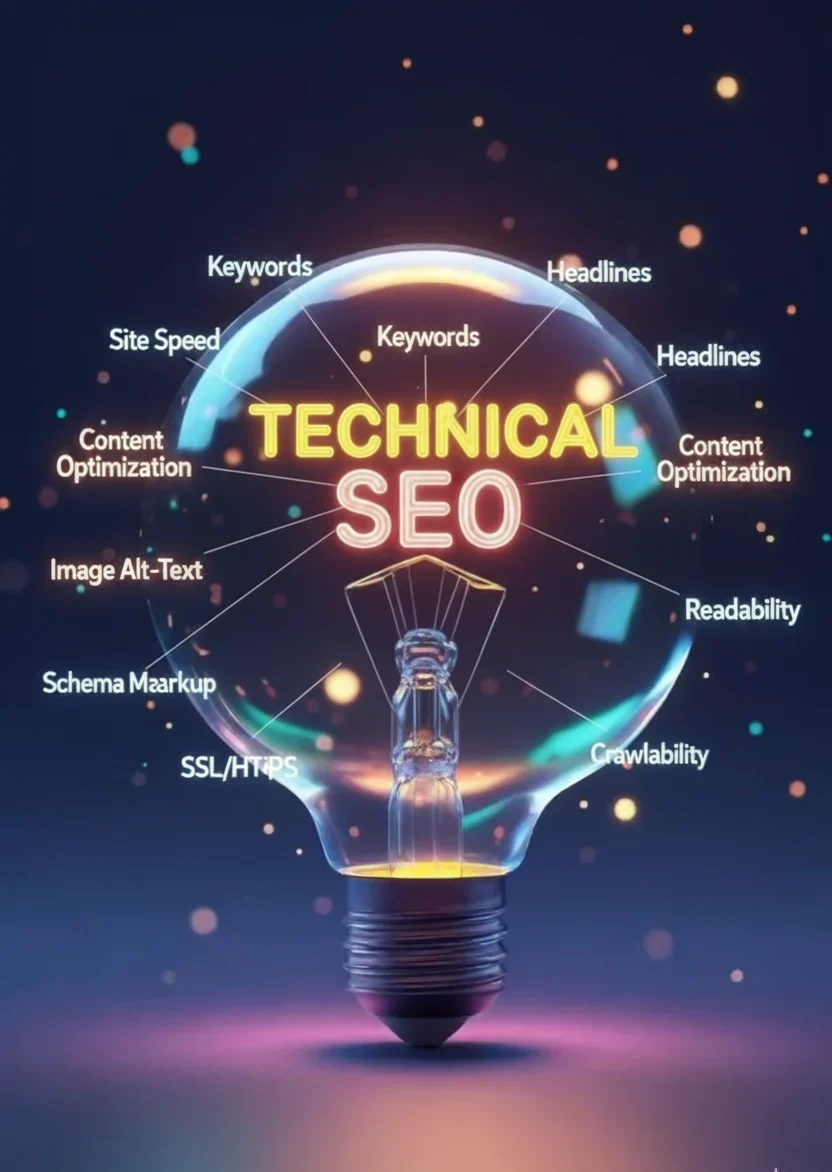
Technical SEO is the practice of enhancing the technical configuration of your website to enable search engines to find, read, and display your website in search results easily. It is concerned with the back-end architecture of your website and not the content. Having a solid technical SEO foundation enables your website to work better, load quickly, and offer a seamless experience to users.
The primary components of technical SEO are website speed, mobile responsiveness, and secure protocol (HTTPS). It also entails repairing damaged links, developing a simple URL structure, and submitting the right sitemap in order to enable search engines to crawl your pages. Another significant component is ensuring that your site is free from duplicate content and that all your pages are crawlable.
When your site loads quickly, is mobile-friendly, and is in good order, search engines can comprehend it better — which increases your odds of a higher ranking. Technical SEO in simple terms is ensuring that the engine under your site's hood is working flawlessly so that everything flows as smoothly for users as well as search engines.
HOW WILL OUR SEO EXPERTISE TRANSFORM YOUR BUSINESS?
-
Visibility
Highlights ranking and reach
-
Performance
Shows measurable results
-
Elevation
Conveys growth and rise
-
Optimization
Directly ties to SEO
-
Enhancement
Subtle yet sophisticated
TECHNIQUES OF SEO
WHITE HAT
White hat SEO involves moral and accepted practices to enhance a website's search engine ranking. It aims to deliver value to the user in the form of quality content, correct keyword implementation, easy site navigation, quick loading time, and mobile responsiveness. Practices such as producing helpful blogs, title and meta description optimisation, utilising internal linking, and acquiring organic backlinks come under white hat SEO. These methods adhere strictly to the rules of search engines so that the site develops organically and in a secure manner with time. Although outcomes could be slower, white hat SEO builds lasting trust, credibility, and long-term web growth.


BLACK HAT
Black hat SEO employs unethical strategies which attempt to fool search engines for instantaneous results. Some common methods include keyword stuffing, concealing text, duplicate content, spammy backlinks, and cloaking. Although black hat SEO can temporarily increase rankings, it violates search engine policies, and the website can be at risk of penalty or being suspended from search results. These strategies target algorithm manipulation instead of assisting users and tend to deliver poor user experiences. Companies employing black hat SEO might experience quick but temporary gains, with the possible harm done to reputation or traffic being extreme.
GREY HAT
Grey hat SEO is a combination of safe, ethically sound SEO (white hat) and dangerous, rule-violating SEO (black hat). It doesn't strictly adhere to search engine guidelines but isn't entirely incorrect either. For instance, using keywords a bit too excessively, purchasing links from less prominent sites, or incorporating automation tools to a reasonable extent are referred to as grey hat methods. These strategies can make your site rank quicker than adhering strictly to white hat SEO, but there is some risk involved—search engines could possibly penalize your site if they detect it as manipulative. Grey hat SEO will be most effective when carried out cautiously, growing slowly while still making your website safe and reputable.

FAQ ON SEO
AI content, voice search, E-E-A-T, and Core Web Vitals are leading SEO trends this year.
Keyword research is finding words and phrases that users search for, then optimizing content around those terms to improve visibility and ranking potential.
AI tools (like Google’s Gemini and RankBrain) analyze user intent, context, and content quality. SEO strategies now need more natural, humanized, and intent-driven content rather than keyword stuffing.
Typically, it takes 3–6 months to see noticeable results depending on competition, content quality, and site health.
LEVERAGE SEO TOOLS FOR MAXIMUM WEBSITE PERFORMANCE


