

Artificial Intelligence (AI) has transformed the way businesses interact, engage, and adapt on the web. What was futuristic in conception is now the central piece of every successful digital marketing campaign. From personalised advertising to AI-powered customer support, AI is revolutionising marketing, making it smart and stronger than ever.
In this blog, we’ll explore how AI impacts digital marketing, why it matters, and how businesses can use it to stay ahead in 2025 and beyond.

What Is Artificial Intelligence in Digital Marketing?
Artificial intelligence in digital marketing refers to the use of machine learning algorithms, data analytics, and automation to make marketing decisions, predict outcomes, and enhance customer experiences.
In simpler words, AI helps marketers:
- Understand what customers want.
- Guess what they will do next.
- Make marketing messages more personal.
- Eliminate tedious tasks.
- Improve performance with data.
It’s whether optimising ad campaigns smarter, creating content, or responding to customers in real time — AI reigns supreme in today’s marketing world.

Why AI Is a Game-Changer in Marketing?
Before AI, marketers relied on human guessing and manual data analysis. Campaigns were primarily assumption-led and not data-driven. Today, AI technology crawls millions of data points in seconds to generate predictions in real-time and personalised solutions.
This is how AI is a game-changer:
- Saves time and effort: AI automates email marketing, ad optimisation, and reporting.
- Delivers personalisation: It personalizes messages based on each customer’s interest and behavior.
- Improves ROI: AI insights help businesses reach the optimal audience and reduce waste spend.
- Makes decision-making easier: Data-based recommendation takes away guesswork.
- Constant customer interaction: Chatbots and AI assistants interact with customers 24/7.
- Easy and efficient, AI allows marketers to eliminate the creative block, with technology handling the data.
- The Trends that Will Define AI and Digital Marketing Trends.
Now, let’s explore the most important ways in which artificial intelligence is transforming the digital marketing landscape of 2025.

1. Personalized Experiences and Marketing
The largest advantage of AI is personalization. With AI, you can see a user’s browse history, purchase, and likes and send hyper-personalized marketing messages.
Example:
If you look for something on the internet and then receive the same suggestions through your email or social notifications — that’s personalization with AI at work.
How it helps:
- Enhances conversion rates
- Develops loyal customers
- Increases user satisfaction
- Marketers can now create personalised experiences on their own with the help of tools like Dynamic Yield, Adobe Sensei, and HubSpot AI.

2. AI-Driven Content Creation
Content is the oxygen of online marketing — and AI is revolutionizing the way it’s being done. ChatGPT, Jasper, and Copy.ai are just a few examples of tools that can produce strong blog posts, ad copy, product descriptions, and social media headlines.
Advantages:
- Speeds up content creation
- Ensures consistency of branding and tone with ease
- Generates ideas for blog posts, keywords, and themes
But AI content needs to be human-touched for creativity, facts, and emotional appeal. The best approach is the marriage of AI productivity and humans’ story ability.

3. Intelligent SEO Strategies
AI constantly accelerates search engine optimisation (SEO) innovations. Google’s AI-driven algorithm updates (e.g., RankBrain and BERT) understand search intent, not keywords.
Today, marketers use AI tools like SurferSEO, MarketMuse, and Clearscope to analyze content quality, rank prediction ability, and optimise based on user intent.
AI for SEO assists in:
- Quicker keyword trends identification
- Voice and visual search enhancement
- Site structure and UX optimization
- AI ranks your content — and engages with your audience.

4. Predictive Analytics and Data Insights
AI is trained on data. Predictive analytics uses machine learning to forecast the future based on what has happened in the past.
Example:
- Online retailers can forecast which products will sell more.
- Marketing teams can know which leads are likely to convert.
It makes companies more intelligent, data-driven decisions instead of guessing what works. Google Analytics 4, Tableau AI, and Salesforce Einstein are some tools that make predictive marketing easy.

5. Chatbots and Conversational Marketing
AI-powered chatbots are the new face of customer service. They respond to questions, provide products, or even sell — in real-time.
Sophisticated chatbots will use Natural Language Processing (NLP) by 2025 to understand tone, mood, and context, providing human-like conversation 24/7.
Advantages:
- Improves response time
- Lowers support cost
- Improves customer satisfaction
Drift, Intercom, and ChatGPT-based bots are examples which communicate with the customer in real-time; thereby, no lead is lost.

6. AI in Social Media Marketing
Social media platforms like Facebook, Instagram, and LinkedIn use AI algorithms to decide what content customers see, when they see it, and what ads perform best.
Marketers use AI for:
- Social listening (brand mentions tracking)
- Predictive trends
- Targeted and optimized advertising
AI also assists in developing visually engaging social media content through platforms like Canva Magic Studio or Lumen5, which can automatically turn text into engaging videos.

7. Programmatic Advertising
Programmatic ad buying uses AI to buy and sell ad space programmatically in real-time. What it does is ensure that your ad appears in front of the correct person, at the correct time, on the correct platform.
How it works:
- AI scans user data
- Selects which ad will perform the best
- Automatically bids
What does it do?
Better ad performance, cost reduction, and higher ROI.
There are quite a number of well-known ones, like Google Ads Smart Bidding and Adobe Advertising Cloud which are based purely on AI technology.

8. Voice and Visual Search Optimization
With smart speakers like Alexa and Google Assistant on the rise, voice search optimization is becoming more popular. Natural conversational patterns of speech and conversational search queries are embraced by AI.
Similarly, visual search with AI allows the user to upload a picture and find lookalikes — used by sites like Pinterest and Google Lens.
Below are the marketing strategies that marketers must adapt:
- Apply conversational keywords in voice SEO
- Add alt text and structured data for visual search
- All of these developments make it easier for users to locate your brand in novel ways.

9. AI-Powered Email Marketing Automation
Email marketing is also changing with AI-enhanced personalization. Instead of sending generic one-size-fits-all newsletters, AI platforms can:
- Automatically segment users
- Suggest when to send emails
- Personalize subject lines and copy
Software like Mailchimp AI, Klaviyo, and HubSpot enable effective delivery of targeted messages that convert and engage at the expense of time savings.
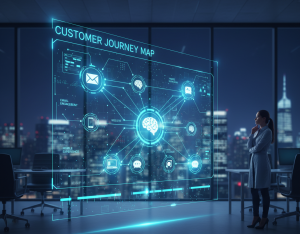
10. AI for Customer Journey Mapping
AI can map a customer’s journey across different disconnected platforms — from initial website visit to last purchase — and determine critical touchpoints for engagement.
It benefits marketers in the following manner:
- Having the ability to see what converts.
- Sending messages at the optimal time.
- Enhancing overall customer experience.
- With AI, each touchpoint in the journey can be tracked and optimized.
- Challenge of Implementing AI in Marketing.
Although AI holds unlimited benefits, there are a couple of issues marketers need to look out for:
- Issue of data privacy – User information needs to be treated ethically.
- High initial cost – There are expensive AI tools to buy.
- Over-reliance on data quality – Poor data renders predictions useless.
- Need for human oversight – AI cannot replace human creativity and emotion.
- The key is to use AI as an aid, not a replacement.

The Future of AI in Digital Marketing
The future of digital marketing is undeniably AI-driven. With continuous advancements, we’ll see even more intelligent tools that can predict behaviour, write content, analyse emotions, and optimise performance automatically.
In 2025 and beyond, AI will:
- Create hyper-personalization as a new standard.
- Bend automation with emotion.
- Create smarter storytelling with data.
Those firms that adopt AI early will attain a significant competitive advantage — reaching customers faster and providing better customer experiences.

Last Words
Digital marketing is revolutionized by the influence of artificial intelligence. It’s changing how brands get seen, connect, and keep users.
From smart SEO to future forecasting, AI is equipping marketers to make informed decisions without losing the human touch.
Success in the future will hinge on how well marketers are able to balance automation with authenticity.
In short—AI doesn’t replace marketers; it empowers them. The future belongs to marketers who apply AI creatively, responsibly, and strategically.