Facebook advertising still provides one of the most effective avenues to reach your ideal customers online. Though new social platforms have gained popularity among users, Facebook continues to head the digital advertising landscape, thanks to its powerful system for targeting and its potential to convert brand awareness into measurable sales.
With over 3 billion monthly active users and deep integration with Instagram and Messenger, Facebook lets businesses of all sizes reach customers where they’re already spending time. Whether you’re a small business, freelancer, or digital agency, Facebook ads can help you generate leads, boost sales, and grow your brand—even on a small budget.
In this guide, you’ll learn some Facebook advertising strategies to help you get better results and more conversions.
Why Facebook Advertising Works

Facebook stays strong as an ad platform because of three main reasons:
- It allows targeting the audience with precision based on behavior, demographics, interests, and previous engagement.
- It offers budget flexibility, which ensures you can start off with a small amount and scale up gradually.
- It supports various creative formats such as video, carousel ads, reels, and lead forms for testing and experimentation.
Facebook is not just an advertising tool but a data-driven marketing machine. When you run ads, Facebook learns who interacts with your content and optimizes the delivery toward the people most likely to convert.
Understand Facebook’s Ad Structure
Any successful advertis ing must firstly understand the structure of a campaign. Any advertisement on Facebook involves a campaign, an ad set, and an ad.
The campaign is the level at which you define your objective: what you want Facebook to actually do for you (drive sales, generate leads, drive traffic and other website conversions, generate page, post, and event engagements, etc.).
The ad set is where you define your targeting, budget, schedule, placement, and optimization settings.
The ad is the creative part—image, video, headline, and call-to-action button.
Consider this analogy: planning a project is often compared to
The campaign is the objective.
The ad set is the strategy.
The ad is the execution.
Choosing the Right Campaign Objective

One of the most common mistakes advertisers make involves choosing the wrong objective. Facebook shows your ad to the people most likely to take the action you choose. If your goal is sales, but you choose “engagement,” your ad will go to people who like posts—not those who buy.
Select the objective according to your intent for marketing:
Use Brand Awareness or Reach when you want to introduce your business to new people.
Use Traffic when the goal is to send users to your website or landing page.
Use Engagement to get more likes, shares, comments, or video views.
Leads—Use this if you wish to capture customer details via instant forms, WhatsApp messages, or calls.
Use Conversions-Sales if you want purchases on your website or app.
Pro-tip: If your objective is to drive conversions—either a purchase or a lead—start with the Leads or Conversions objective for best results.
Targeting Strategies That Drive Results
Facebook offers three main layers of audience targeting. Using all three helps you create a strong funnel strategy.

1. Cold Audience Targeting (People who don’t know your brand yet)
This is the top of the funnel: Here, you’ll target new users based on:
- Interests (examples: fitness, real estate, marketing, beauty)
- Demographics: age, gender, income range, location
- Behaviors: online shoppers, recent movers, device type
Tip: Start broad, as opposed to too narrow. Too much filtering can narrow down ad reach.
2. Warm Audience Targeting: People who already interacted with you
These are people who have the:
- Liked your posts.
- Watched your videos
- Visited your website
- Added products to cart but didn’t buy
Of course, these audiences produce higher conversions because they already know your brand.
3. Lookalike Audience (People similar to your best customers)
Facebook identifies individuals who resemble those who have already interacted with or bought from you. Start with a lookalike from your best-performing audience, such as website conversion data.
High-Converting Ad Creatives and Copy

Your ad visuals and text are what stop the scroll. Focus on three things:
- Capture attention: strong headline, bold creative, short video
- Communicate value—how your product solves a problem.
- Encourage action (clear CTA)
Ad creative best practices:
- Use ultra-short videos of 6–15-second duration for product demos.
- Include faces or lifestyle images—they perform better than stock photos.
- Use a clear CTA, such as “Shop Now,” “Learn More,” or “Book Free Demo.”
Writing Advertisement Copies—Some Tips
- Hook: The first line should be relatable to stop the scrolling.
- Value: Describe why your offer is unique.
- Proof: Add credibility such as reviews, testimonials, or numbers.
- CTA: Direct users about what to do next.
Most importantly, keep your copy simple and your message direct.
Budget Optimizing Tips
Most businesses assume that the higher the budget, the better the results will be. But Facebook works best when you test and analyze first before scaling.

Smart budgeting strategies:
- Start small. Begin with a small budget to test different audiences and creatives.
- Avoid making sudden changes to the ad, but rather let it run for 3–5 days.
- Scale what works: when an ad is performing well, increase its budget over time.
- Always test instead of guessing. Data wins.
- Retargeting—The Secret to High ROI
Retargeting is when you show ads to people who have already interacted with your brand. These audiences convert better because they are already familiar with you.
You can retarget:
- Visitors who viewed your website
- Users who clicked your ad but didn’t convert
- People who added products to cart but didn’t buy
Examples of Retargeting Ads:
Offer discount codes. Example: “Still thinking? Get 10% off.”
Showcase customer testimonials
Use urgency: “Hurry! Last few pieces left!
Retargeting works because the audience already has purchase intent.
Track and Measure Everything
You can’t improve on what you’re not measuring. Facebook Pixel and conversion tracking enable you to monitor results and optimize campaigns.

Track metrics such as
- Cost per click
- Cost per lead
- Add-to-cart rate
- Sales conversion rate
- Return on Ad Spend (ROAS)
Instead of focusing on likes or impressions, focus on metrics that drive revenue.
Final Thoughts
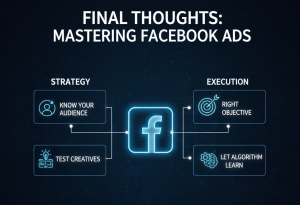
Facebook advertising isn’t about creating an ad and crossing your fingers anymore. It’s about really knowing your audience, testing creatives, picking the right objective, and letting the Facebook algorithm do the learning.
Success stems from:
- Choosing the right objective
- Targeting the right audience
- Using striking creatives
Continuous tracking and optimization Start small, test often, learn from the data, and scale up with confidence. Facebook ads are powerful, but it’s strategy that turns clicks into conversions.