

All businesses desire to be unique and attract the right audience at the right time in the competitive online age today. One of the finest ways of achieving this is through Pay-Per-Click (PPC) advertising. PPC is a fast and reliable form of online advertising that offers immediate visibility, quantifiable results, and control over your marketing budget.
Whether you are a small business owner or a digital marketer desiring to expand campaigns, it’s crucial to know PPC. In this detailed guide, we are going to explain what PPC is, how it works, different types of advertisements, and how to keep it in the best shape for maximum returns.
What is PPC?

PPC (Pay-Per-Click) refers to an internet advertising system whereby advertisers pay a small amount each time an individual clicks on their ad. In simple terms, instead of receiving website visitors for free via SEO, PPC allows you to buy targeted traffic instantly.
For example, if you advertise on Google about the “best digital marketing agency,” your advertisement can appear at the top of search engines. You pay only if an individual clicks on your advertisement to visit your site.
PPC is run on numerous platforms like Google Ads, Facebook Ads, Instagram Ads, LinkedIn Ads, YouTube, etc. It’s highly flexible—you get to set your budget, audience, and placement with high levels of precision.
Why Use PPC Marketing?

PPC is an extremely rapid and impactful way to promote your business over the internet. Here’s why it’s so popular and effective:
1. Immediate Results: Unlike SEO, which can take months to produce results, PPC gives you immediate visibility. With your campaign set, your ads can start showing up on search pages or social media streams in as few as minutes.
2. Targeted Advertising: PPC lets you target the appropriate individuals by location, interests, device, demographics, and even behavior. This implies that your budget goes to individuals most likely to convert.
3. Budget Control: You decide exactly how much you wish to pay every day or every click. PPC networks like Google Ads let you set a maximum bid so you never spend too much.
4. Measurable and Trackable: Every impression, click, and conversion can be measured. That means that you can determine your return on investment (ROI) and optimize your campaigns for better performance.
5. Increases Brand Visibility: Although your ad may not be clicked, showing up with your brand name over and over increases awareness and credibility.
PPC is not limited to big companies. Small and medium enterprises can make the most of it to compete with big companies and reach local or niche consumers.
Cheat sheet: Dealing with PPC Acronyms
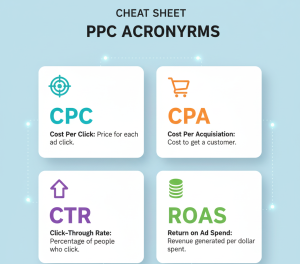
If you are new to PPC, you might encounter several terms that will seem confusing at first glance. This is a quick overview of some crucial PPC terms:
- CPC (Cost Per Click): The amount you pay for every click on your ad.
- CPM (Cost Per Mille): Cost per 1,000 impressions, typically applied for brand consciousness campaigns.
- CTR (Click-Through Rate): The proportion of users who click on your advertisement after displaying it. The higher CTR usually signifies that your advertisement is more engaging and relevant.
- CPA (Cost Per Acquisition): The amount of money that you spend on average to gain a customer or lead.
- ROAS (Return on Ad Spend): A measure of revenue drawn for each rupee or dollar used to advertise.
Quality Score: A Google Ads metric that indicates how relevant and high-quality your ads and landing pages are. Better quality scores tend to result in lower costs and improved ad positions.
Ad Rank: This determines where your ad appears on the search results page, depending on your bid value, Quality Score, and other factors.
Understanding these basic terms will help you to examine your campaigns and make more informed PPC choices.
Common PPC Platforms

There are several platforms where you can operate PPC campaigns. The selection will rely on your audience, goals, and area of interest.
- Google Ads: The largest and most popular PPC platform in the world. It displays your ads on Google search pages and on its massive network of partner websites. Great for search intent and lead generation.
- Microsoft Ads (Bing Ads): Basically a Google Ads alternative, but usually cheaper and less competitive. It has potential for good ROI, especially with older audiences.
- Facebook Ads: Ideal for awareness and targeting by interest, demographics, or behavior. Ideal for both service and e-commerce businesses.
- Instagram Ads: Highly visual and excellent for product- or lifestyle-focused brands. It integrates well with Facebook Ads Manager.
- LinkedIn Ads: The best choice for B2B advertising, targeting professionals by job title, industry, or company size.
- YouTube Ads: Great for storytelling and brand awareness. You can run video ads as pre-rolls or mid-rolls on your YouTube videos to target an enormous audience.
- X (formerly Twitter) Ads: Good for engagement campaigns, popular hashtags, and brand awareness.
Each platform has some set of targeting features and ad formats, and therefore the optimal strategy typically entails a mix of platforms for optimal coverage.
Types of PPC Ads

PPC advertisements offer a number of types of ads to help brands achieve certain marketing goals. These are the most common ones:
1. Search Ads: Text-based ads that show up at the top of the Google or Bing search list after a person looks for a particular keyword. Most appropriate for high-intent traffic.
2. Display Ads: Visual or banner ads shown on websites on Google’s Display Network. Best for brand recall and remarketing.
3. Shopping Ads: Product ads with images, prices, and brands. They are most often used by e-commerce stores to drive sales.
4. Video Ads: Ads played on YouTube or social media. Video ads are great for stories and emotional engagements.
5. Social Media Ads: Paid ads that are put on platforms such as Facebook, Instagram, LinkedIn, and Twitter. They become part of users’ streams and respond to particular interests.
6. Remarketing Ads: Ads that remind users who have already visited your website but didn’t convert. These ads encourage potential customers to return and purchase or inquire.
By employing a combination of these types of ads, your company can attract attention, generate clicks, and convert visitors cost-effectively.
Why PPC Works? (3 Key Reasons)

1. Immediate Results: PPC adverts can start generating traffic as soon as your campaign goes live. It’s the fastest way of gaining leads and customers.
2. Targeted Reach: With the advanced capabilities of targeting, you can ensure your ads reach people who are genuinely interested in your product or service.
3. Performance-Based: Unlike traditional advertising, where you pay for each time the ad is shown, PPC only charges you when the individual clicks your advertisement, thus ensuring your money is being put to optimal use.
These three benefits make PPC one of the most reliable and result-driven digital marketing tactics.
What Constitutes a Strong PPC Account?

Running a successful PPC campaign requires planning, strategy, and continuous optimization. This is what constitutes a strong PPC account:
- Crystal Clear Goals: Define what success for you is—traffic, leads, or sales.
- Accurate Keyword Research: Choose top-relevant and high-intent keywords appropriate for your products or services.
- Effective Ad Copy: Write succinct, engaging ads with concise calls-to-action (CTAs) that engage users to click.
- Optimized Landing Pages: Your landing page should reflect the message of your ad and provide a smooth, mobile-optimized experience to get conversions.
- Constant Monitoring and A/B Testing: Continuously test different versions of your ads, keywords, and landing pages to find out what works best.
- Proper Tracking: Use Google Analytics and conversion tracking to track performance and ROI.
A successful PPC account is built on data and consistency. Continuous analysis and adjustment guarantee ongoing improvement over time.
How Much Does PPC Cost?

There is no fixed cost for PPC—it depends on your platform, competition, and goals. You have total control over your budget throughout.
On average:
Google Search Ads can range between ₹10 and ₹300 per click, depending on the keyword and niche.
Facebook Ads range between ₹5 and ₹50 per click.
LinkedIn Ads are more, between ₹50 and ₹400 per click, since they are targeting professionals.
Your expense will be based on your bid strategy, ad quality, and competition. The key is to start small, check the performance, and increase gradually as you get good ROI.
Do I Manage My PPC Accounts In-House or Outsource?

PPC campaign management requires time, effort, and expertise. You can manage it yourself or hire experts to do it.
In-House Management:
In-house campaign management gives you complete control and quick decision-making. But simultaneously, it requires deep expertise in PPC platforms, continuous learning, and regular monitoring. If you or your team members lack experience, it may take time to achieve excellent results.
Outsourcing to an Agency or Expert

PPC agency recruitment allows you to hire services from skilled professionals to manage campaigns in the best possible way and implement sophisticated techniques to bring optimal ROI. They give industry knowledge, handle reporting, and improve your campaigns on an ongoing basis. It might cost you some extra, but it generally performs in a more favorable way in the long term.
For medium or small businesses, outsourcing PPC to an online marketing company is usually the more intelligent choice, as it saves time as well as assures professional management.
Final Thoughts

PPC advertising is likely one of the most effective weapons for generating immediate, measurable, and focused traffic. Well-planned, it has the potential to become a phenomenal generator of results and enable your business to develop at an unparalleled pace.
By mastering PPC, you can take control of your online presence, boost conversions, and turn every click into a valuable customer.